


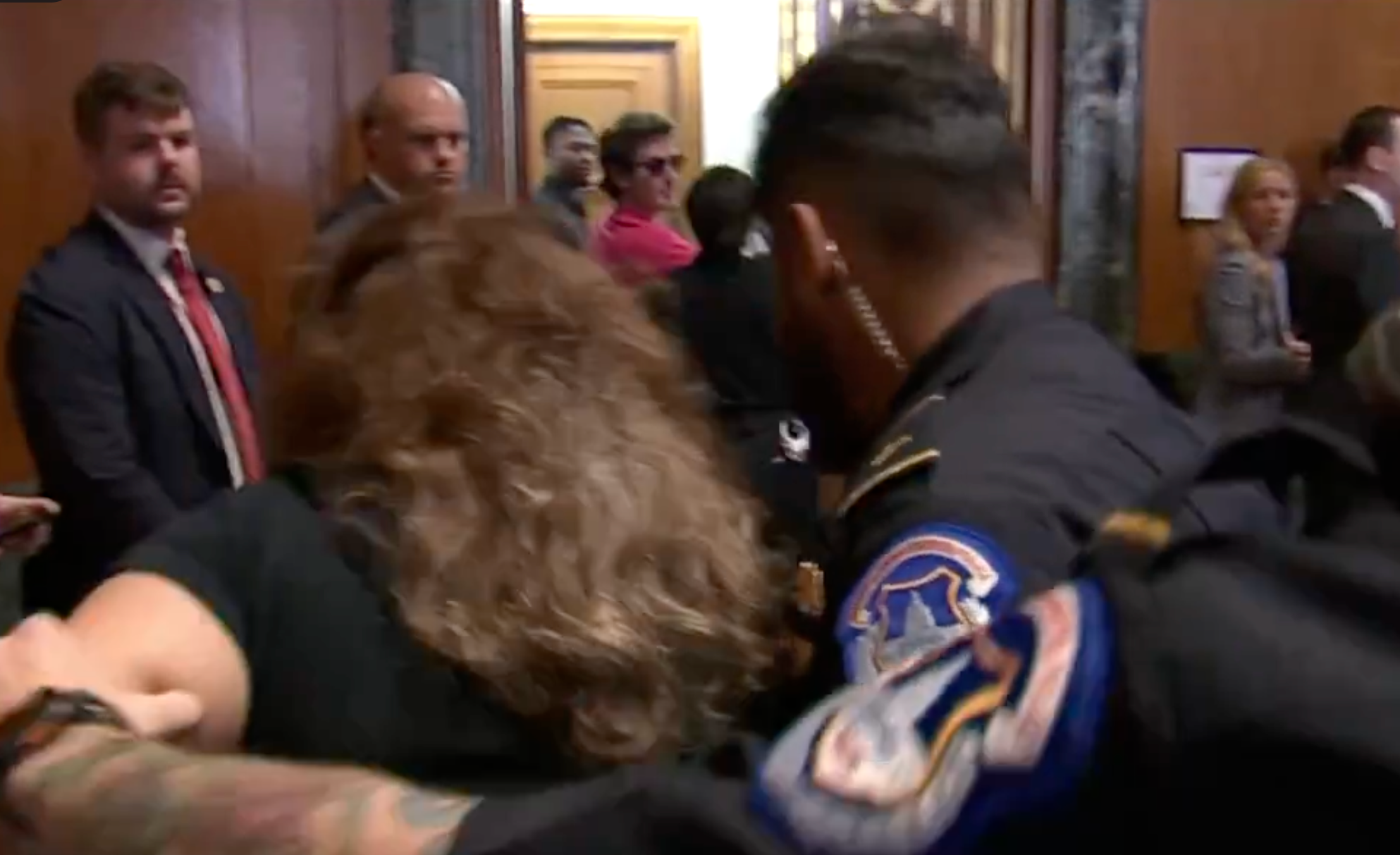
WASHINGTON (AP)—U.S. Secretary of War Pete Hegseth made an appearance before a budget hearing of the Senate Appropriations Committee's defense subcommittee on Thursday. The hearing room was packed and there were a handful of anti-war protesters in the audience as well.
As Hegseth started his opening statement, a woman stood up and pronounced, “I am an Iranian American and against this war of aggression.”
Within moments, she was removed from the hearing room by Capitol police offers, but she continued to tell the hearing room she was opposed to the war with Iran.
There were a handful more anti-war protesters wearing pink shirts sitting in the back row of the Senate hearing room, but they remained silent. Several of them stood and walked out while Hegseth was talking.
Hegseth faced tough questions Tuesday from Republican and Democratic lawmakers about the Trump administration's end game for the Iran war, the cost of the conflict and its impact on diminishing U.S. weapons stockpiles.
While the Pentagon chief softened his tone from hearings before Congress nearly two weeks ago, notably avoiding the same pointed criticism of lawmakers, he got far more pushback from members of his own Republican Party about the levels of the U.S. munitions used in the Iran war and President Donald Trump’s intense criticism of traditional allies, including NATO countries, for not taking part in the conflict.
“I take issue with the characterization that munitions are depleted in a public forum,” Hegseth told House lawmakers. “That’s not true.”
Even as he insisted that the U.S. military has plenty of missile defense systems and other munitions for the Iran war or future conflicts, Hegseth outlined the Trump administration’s efforts to ramp up production of weapons and other military capabilities in two hearings before Senate and House panels.
The cost of the Iran war has risen to about $29 billion, the vast bulk of which — $24 billion — is related to replacing and repairing munitions but also includes operational costs to keep forces deployed, Pentagon comptroller Jay Hurst told lawmakers. That's up from $25 billion that he told lawmakers nearly two weeks ago.