


JEFFERSON CITY, Mo. (AP) — The U.S. Supreme Court again rejected a Missouri congressional map backed by President Donald Trump on Thursday, a loss for Republicans hoping to gain another seat as they try to maintain control of the House in the pivotal midterm elections.
The decision could mark a defining moment in a pitched legal battle that has caused confusion for voters. Missouri’s chief election official acknowledged that it clears the way for the state to use U.S. House districts passed in 2022, as the state’s highest court had ordered. The Trump administration had urged the court to use the president’s preferred map drawn at his request last year.
The decision means Missouri could run the November general election with different U.S. House districts than were used in the August primary — an extremely rare situation that could switch the candidate choices for more than a million potential voters, or nearly 1-in-4 voters statewide, according to an Associated Press estimate.
No Supreme Court justices publicly dissented from the brief order. It did not detail the court’s legal reasoning, as is typical in emergency appeals.
The White House did not immediately respond to a request for comment on the U.S. Supreme Court decision.
Missouri top court scrutinizes secretary of state’s actions
Meanwhile, the legal fight featuring dueling orders from different courts continued in Missouri, where the state’s top court convened a hearing Thursday on whether to hold Republican Secretary of State Denny Hoskins in contempt for not following its orders to use the districts passed after the last census. Hoskins had instead told local election authorities to use the new Trump-backed map, pointing to a competing order from a federal judge on Tuesday that forbade him from using anything other than the new districts.
Missouri Supreme Court judges, while questioning a state attorney representing Hoskins, repeatedly pressed for Hoskins to send out guidance Thursday to use the 2022 version of the congressional districts. The court made no immediate decision on whether to hold Hoskins in contempt but urged him not to stray too far from the state’s capital of Jefferson City.
“We’re in a precarious situation,” Chief Justice W. Brent Powell said.
Hoskins sat silently in the center of the courtroom’s front row and left without answering reporters’ questions. Hoskins later released a statement acknowledging the U.S. Supreme Court decision, saying “my Office is directing local election authorities to use the 2022 congressional map.”
Missouri voters could face significantly different districts
Outside the court, progressive activist Keith Rose stood in the rain protesting Hoskins’ legal maneuverings to try to use the Trump-backed map. Rose, who helped gather petition signatures to put the new map to a statewide vote, said he hopes the U.S. Supreme Court’s decision Thursday ends the uncertainty.
“We need some finality. We need to focus on the real issues that Missourians care about,” Rose said.
Candidates who won Missouri’s August primary already have been certified for the November ballot according to the number of the district that they won. But those districts could substantially change shape.
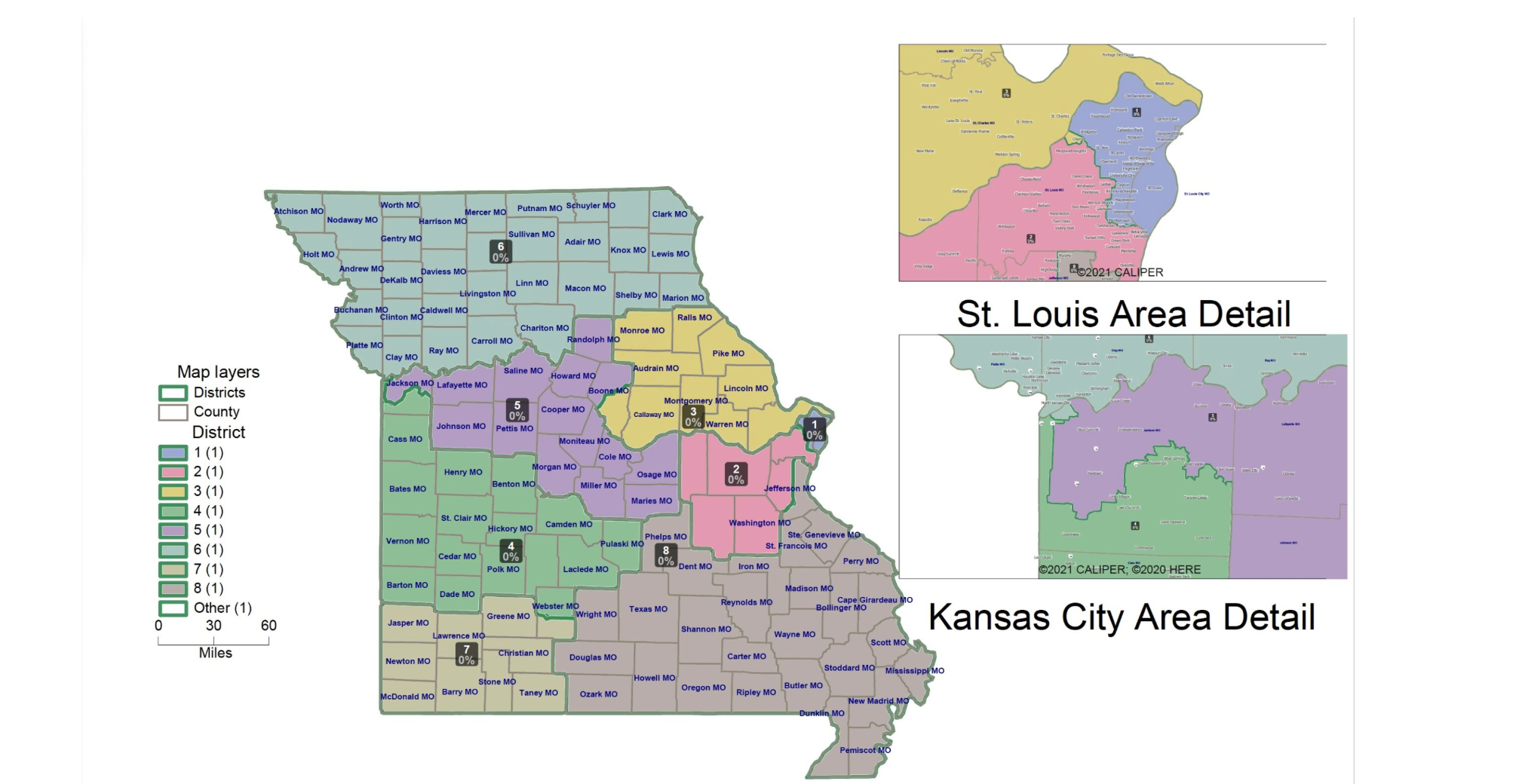
The 5th Congressional District encompasses only the Kansas City area under the 2022 map that Republican lawmakers passed after the last census. But under the revised map backed by Trump, portions are shed to neighboring districts and the remainder is stretched into rural Republican areas. About 59% of the potential voters are new to the district under that version, according to an AP estimate.
Some other states that have switched congressional districts after their primaries have redone their primary votes. Alabama held a new primary in August under revised districts when the U.S. Supreme Court allowed a change to occur after voting in the original May primary.
In Missouri’s case, however, no court has suggested redoing the primary.
The redistricting battle began over a year ago
Missouri’s battle over its congressional districts has spanned more than a year and spawned confusion over which districts will be in place for voters.
It was the second Republican-led state, after Texas, to enact new districts after Trump urged Republicans last year to redraw House districts to their advantage ahead of the midterm elections.
The revised districts target a Kansas City-based seat held by Democratic Rep. Emanuel Cleaver of Kansas City, aiming to help Republicans win seven of the state’s eight House seats in the midterm elections.
Redistricting opponents collected hundreds of thousands of petition signatures seeking to force a statewide vote on the new districts. They submitted the signatures in December. But Hoskins waited until August — on the same day as Missouri’s primary — to reject the petition. Hoskins asserted that a referendum petition could not be used for congressional redistricting.
The delay allowed Missouri to use the new districts in its August primary. Cleaver was unopposed for the Democratic nomination. State Sen. Rick Brattin won the Republican primary for the right to challenge Cleaver. Brattin was among those suing in federal court to try to prevent the state from reverting to the prior districts.
Republican state officials have argued it would violate voters’ federal rights to switch districts before the general election.
But the Missouri Supreme Court last week ordered Hoskins to put the redistricting referendum on the November ballot, which he did. It also ruled that the new districts never became law and instead were suspended retroactively to the December petition submission. The court barred Hoskins from using the new map and said the old map — passed by Republican lawmakers in 2022 after the last census — must be used in the November election.
The state then appealed to the U.S. Supreme Court to block the state court decision. Justice Brett Kavanaugh rejected the request.
The group People Not Politicians Missouri, which sponsored the redistricting referendum, applauded the Supreme Court decisions that left the state court ruling in place.
“The law is the law, the Missouri constitution is clear as was the Missouri Supreme Court,” said Executive Director Richard von Glahn. “The courts have settled this, now it’s up to Missouri voters to finish the job and vote NO on Proposition A.”
___----------------------
30JEFFERSON CITY, Mo. (AP) — The U.S. Supreme Court again rejected a push to use Missouri congressional maps backed by President Donald Trump on Thursday, a loss for Republicans trying to maintain control of the House in the pivotal midterm elections.
The decision appears to clear the way for the state to use the old map. There were no noted dissents in the brief order.
It comes after a pitched court battle shortly before ballots begin going out for the November elections. The new map was drawn to help Republicans gain an additional seat.
The Supreme Court order came hours after a federal judge allowed Missouri’s top court to proceed with a contempt hearing against Republican Secretary of State Denny Hoskins. Missouri’s battle over its congressional districts has spanned more than a year and spawned confusion over which districts will be in place for voters.
The state’s top court previously ordered Hoskins not to use a Trump-backed map in the general election and instead use districts passed after the last census. But U.S. District Judge Stephen Clark on Tuesday barred Hoskins from using anything other than the new map Trump supports.
The state Supreme Court then ordered Hoskins to appear for a contempt hearing Thursday for not following its orders and instructing local election authorities to use the Trump-backed districts.
State attorneys representing Hoskins had asked Clark to halt the contempt hearing. But Clark declined to do so.
Missouri was the second Republican-led state, after Texas, to enact new districts after Trump urged Republicans last year to redraw House districts to their advantage ahead of the midterm elections.
The revised Missouri districts target a Kansas City-based seat held by Democratic Rep. Emanuel Cleaver by shedding parts into neighboring districts and stretching the remainder into rural Republican areas. The goal is to help Republicans win seven of the state’s eight House seats in the midterm elections — a gain of one seat.
Redistricting opponents collected hundreds of thousands of petition signatures seeking to force a statewide vote on the new districts. They submitted the signatures in December. But Hoskins waited until August — on the same day as Missouri’s primary — to reject the petition. Hoskins asserted that a referendum petition could not be used for congressional redistricting.
The delay allowed Missouri to use the new districts in its August primary. Republican state officials have argued it would violate voters' federal rights to switch districts before the general election.
But the Missouri Supreme Court last week ordered Hoskins to put the redistricting referendum on the November ballot, which he did. It also ruled that the new districts never became law and instead were suspended retroactively to the December petition submission.
The state then appealed to the U.S. Supreme Court to block the state court's findings. Justice Brett Kavanaugh rejected their request.
The court barred Hoskins from using the new map and said the old map — passed by Republican lawmakers in 2022 after the last census — must be used in the November election. The U.S. Supreme Court on Tuesday declined to hear an appeal of that decision. But Clark issued his conflicting order moments later.
___